

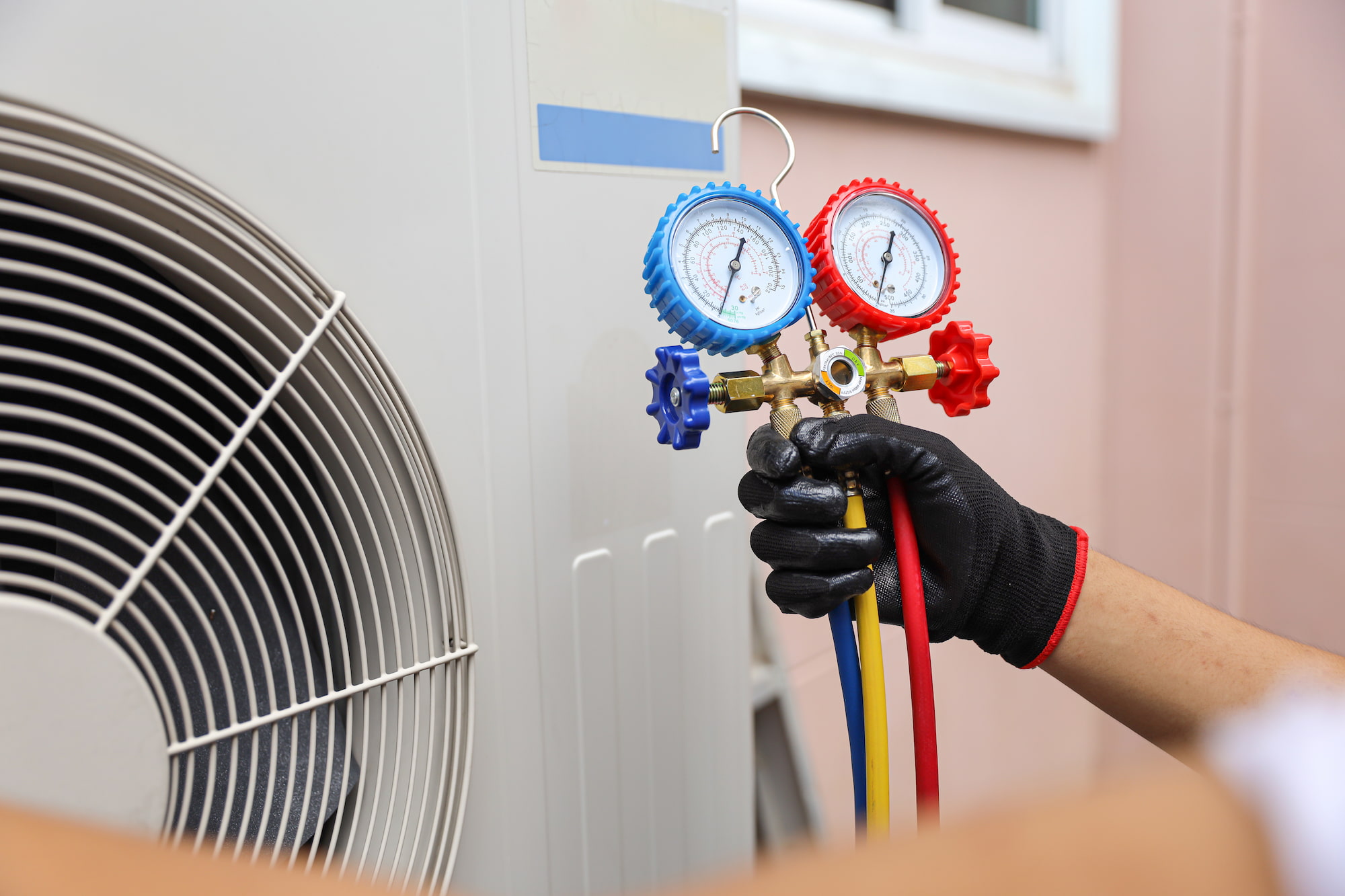
Power outage AC damage in Montgomery County after Hurricane Beryl had a way of hiding until the lights came back on. One Google review written after the storm tells it in order: “Our power was out for 9 days because of Beryl. We were miserable because our A/C wouldn’t run on the generator and when the power came back on, we realized something was wrong with the unit.”
Both problems in that story, the generator and the restart, are covered below. That household got its part replaced and its house cooling again. The review goes on: “This storm was so expensive for us already and Ivan could have taken advantage of us, but he did not.”
What Breaks In The Dark And What Breaks After
A system sitting dead through an outage is mostly waiting. An air conditioner is most exposed in the first minutes of restored power, when it tries to start on a grid that hasn’t settled.
Three problems show up, each with its own cause. A spike as a line is re-energized hits the electronics first, and a control board failure is one way that ends. A voltage sag or a longer brownout makes the compressor strain, and it makes the outdoor contactor chatter. Over a multi day outage, refrigerant drifts where it shouldn’t, so the first start is rougher on the compressor.
Then there are the people inside. July heat without cooling is a health risk before it’s an equipment one.
Why Restoration Power Is Hard On Compressors
A compressor needs full voltage to start. For a fraction of a second it draws several times its running current. On a voltage sag the motor makes less torque, so it turns over slowly and pulls heavy current the whole time. The windings heat, and if it stalls, an internal overload opens while it sits there humming.
A brownout stretches the same problem over minutes or hours. A compressor that keeps trying to start on a brownout can cook its own windings, one failed attempt at a time. Some outdoor controls count failed starts and hold the unit in compressor lockout until the power is cycled. Mention a lockout when you call, because it shows the unit already struggled.
Contactor welding is the quieter failure. The contactor is the relay that sends power to the compressor and fan, pulled in by a 24-volt coil. On low voltage that coil can chatter, and every opening draws an arc across the contacts. Enough arcing fuses them shut. Then the outdoor unit runs whether the thermostat calls for cooling or not, and the start delay can’t protect the compressor.
Refrigerant Migration Through A Long Shutdown
Refrigerant migration starts the moment a system goes quiet. The refrigerant moves as vapor toward the coolest part of the circuit and condenses there. After several days, some of it can settle in the compressor’s crankcase and dissolve into the oil. On the first start that refrigerant boils out all at once. The oil foams and the bearings run short of lubrication.
A crankcase heater keeps the oil warmer than the rest of the circuit, so refrigerant stays out of it. It runs on line power, so it goes cold in an outage like everything else. Not every outdoor unit has one, and a heater only helps if it’s had power for a while before the compressor starts. The installation manual for your model says how long.
Generator Backup And What It Can Carry
Generator backup for central air has to cover the compressor’s start as well as its running load. Sizing a standby generator for that is an electrician’s job, and so is the transfer switch that isolates it from the utility lines. Entergy’s generator safety page is blunt on one point. A generator never feeds house wiring through a wall outlet, because that sends power back toward the line crews.
A soft starter on the outdoor unit ramps the start current up gradually, which can bring a system within reach of a smaller generator. The electrician and the technician should settle that together.
Two Smaller Ways To Keep One Room Cool
- A mini split on generator power is easier to carry, because an inverter compressor ramps its speed up slowly. It still cools one zone, and it still needs an electrician’s connection.
- A portable AC draws less again, but the portable AC limits are real. It cools a single room at best, and its exhaust hose has to go out a window.
The National Weather Service issues a heat advisory for dangerous heat below warning level. Its advice is to stay somewhere cool through the heat of the day and evening. One cooled room with everyone in it is a real plan.
Entergy Territory Is Not CenterPoint Territory
Conroe, Willis and New Caney all sit on Entergy Texas, a regulated utility with no retail choice. Beryl came ashore on 8 July 2024. By that evening, Entergy Texas reported about 247,000 customers out and 34 substations without power. Montgomery County was among the hardest hit.
A substation outage kills every line it feeds, so a whole area comes back in the same instant. Every air conditioner behind it tries to start together. Utilities call that cold load pickup, and the rush of current drags the voltage down just when each compressor needs it. The first minutes after an Entergy restoration are the ones to sit out, with your system switched off.
CenterPoint’s storm was a different one, and its figures belong to CenterPoint. It counted about 2.2 million customers out at landfall and 1.35 million still out on 10 July. Kingwood, on the CenterPoint side, went nine days without power. Anyone comparing notes with Kingwood was comparing two utilities’ crews and timelines.
The storm decides when the power goes out. You decide how your air conditioner meets it when it comes back.
What To Check Before You Flip The Breaker Back On
The restart procedure begins when the lights go out. Set the thermostat to off and switch off the breakers for the outdoor unit and the air handler. A system that’s switched off when the power returns can’t be hurt by the flickers that come with it.
A Restart Sequence For After A Long Outage
- Wait for steady power. Give the lights a good stretch without a flicker. Restoration can drop out once or twice before it holds.
- Look before you power anything. Clear branches and debris off the outdoor unit. A unit that sat in standing water stays off until it’s checked.
- Breaker sequence, indoor first. Turn the air handler breaker back on, then the outdoor breaker, with the thermostat still set to off.
- Give the crankcase heater its time. If your unit has one, that pause with the thermostat off lets it warm the oil.
- Run the fan alone first. A few minutes of indoor fan shows the air handler and thermostat came back. A blank thermostat points toward the board or its transformer.
- Call for cooling and listen. A start delay of a few minutes is normal. A hum with the outdoor fan standing still means shut it off and leave it off.
- Watch the first cycle. An outdoor unit that won’t stop once the house reaches the setting suggests a welded contactor. A breaker that trips twice is protecting a fault, so stop resetting it.
Hard Start Kits And Surge Protection
A surge protective device at the outdoor disconnect or the main panel shunts a voltage spike to ground before it reaches the equipment. It does nothing for a voltage sag or a brownout, and those are what strain a compressor. It also wears out as it absorbs hits.
Low voltage needs its own device. A voltage monitor cuts the compressor out when the supply drops out of range, then holds it off for a set delay after voltage recovers.
A hard start kit is a start capacitor and a relay that give the compressor extra torque for its first second. It helps an older compressor turn over on a weak supply. It protects nothing, though, and on a failing compressor it can hide the warning signs for a season. Whether any of these suits your system belongs in an air conditioning repair service visit, with the readings shown to you.
Before The Next Storm Gets A Name
A calm week in spring is the time to plan surge protection or a generator. Mountain Top HVAC-R works Montgomery County from Conroe, Monday to Friday 8 AM to 7 PM and Saturday 8 AM until noon. A message left after hours waits for Ivan the next morning, with a next day response. Contactors and capacitors fail in quiet summers too, and the common AC failures with no storm behind them are a subject of their own.